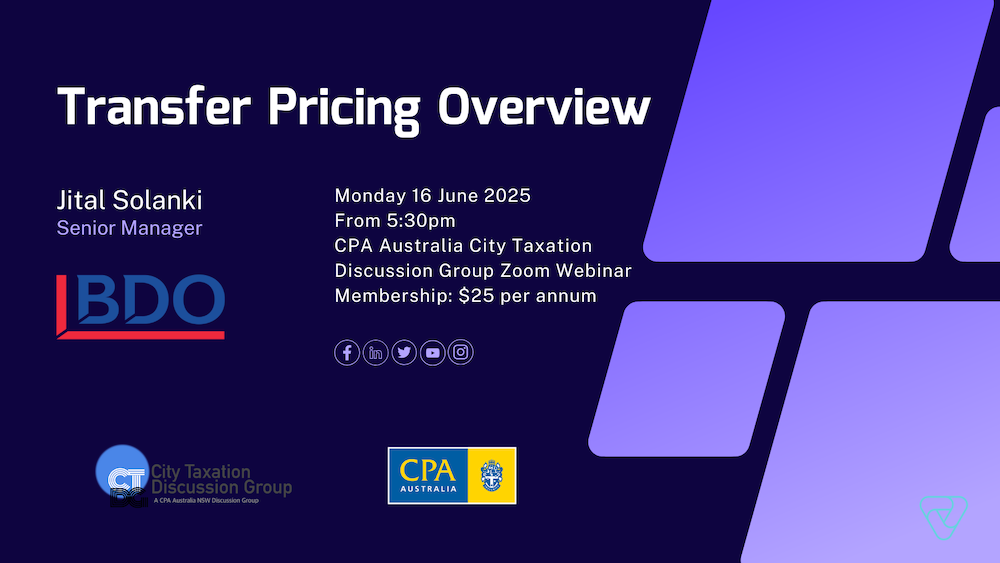
16 June 2025 | Transfer Pricing Overview | By Jital Solanki of BDO Australia


- Description
- Curriculum
- Notice
- Reviews
-
1
 16 June 2025 | Recordings
We note that our live Zoom webinar has been completed.
Please refer to the recordings.
Please note that some videos may be large in file size and may cause the video player to take some time to load. We have attempted to reduce the file size as much as possible.
-
2
 16 June 2025 | Attendance Check
This quiz is set up as a final verification for the CTDG Convenors only. No action is required.
Quick recap
The meeting covered transfer pricing basics, recent developments, and risk assessment strategies in Australia, emphasizing the importance of arm's length pricing and proper documentation. Key topics included significant global entity rules, associated penalties, and the ATO's approach to identifying transfer pricing risks. The speakers stressed the complexity of cross-border issues and recommended seeking external advice for transfer pricing planning and compliance.
Next steps
• Taxpayers to ensure they have appropriate transfer pricing documentation in place before lodging tax returns. • Taxpayers to conduct practical compliance guidance risk analysis to determine their risk profile from the ATO's perspective. • Large multinational groups to assess whether they qualify as Significant Global Entities (SGEs) or Country-by-Country (CbC) Reporting Entities. • SGEs to ensure timely lodgment of all required documents to avoid substantial penalties. • Taxpayers dealing with related parties in cross-border transactions to engage with transfer pricing specialists to ensure appropriate pricing. • Taxpayers to review their intangible arrangements in light of recent ATO guidance (PCG 2023/1). • Highly leveraged Australian taxpayers to review their debt arrangements considering recent ATO guidance on financing. • Taxpayers to disclose their SGE status accurately in tax returns to avoid penalties for misleading statements. • Accounting firms without in-house transfer pricing expertise to consider partnering with transfer pricing specialists for complex cross-border issues.
Summary
Australian Transfer Pricing Basics
Jital explained the basics of transfer pricing, focusing on Australian legislation and compliance guidelines. She described transfer pricing benefits, such as lower taxable income or higher tax offsets, and outlined common transactions that may raise transfer pricing issues, including imports, services, financing, and recharges. Jital emphasized the importance of pricing transactions between related parties at arm's length, as independent parties would, and explained the documentation requirements under section 284E of the Administration Act 1953. She also compared the old transfer pricing rules (Division 13) with the current self-assessment regime introduced in 2014, highlighting the shift in responsibility from the Commissioner to taxpayers.
Australian Transfer Pricing Updates
Jital presented an overview of recent developments in transfer pricing, highlighting key changes in Australian tax rules and ATO policies. She explained that the new rules include a 7-year statute of limitations and reference to OECD guidelines, while the ATO has been promoting behavioral-based transfer pricing and issuing practical compliance guidelines. Jital discussed several important topics including intangibles, recent transfer pricing cases, and the new BEPS 2.0 initiative, noting that public country-by-country reporting will be mandatory for income years starting July 2024.
ATO Transfer Pricing Risk Indicators
Jital explained how the Australian Tax Office (ATO) identifies transfer pricing risks through various sources of information, including international dealing schedules, country-by-country reporting, and IFRIC 23. She highlighted that the ATO uses sophisticated tools and analytics to assess risk levels and target taxpayers for scrutiny. Jital also outlined key risk indicators for the ATO, such as low transfer pricing documentation, international restructurings, and dealings with high-risk jurisdictions. She advised taxpayers to engage specialists for transfer pricing planning, maintain proper documentation, and lodge returns on time to mitigate risks.
Understanding Significant Global Entity Penalties
Jital explained the concept of Significant Global Entities (SGEs) and their associated penalties, highlighting that SGEs face substantial penalties for late lodgments and are subject to additional reporting requirements like country-by-country reporting. She noted that many entities, particularly those owned by private equity firms, may not realize they qualify as SGEs due to complex rules and exemptions, leading to potential penalties. Jital also clarified the distinction between SGEs and country-by-country reporting entities, emphasizing the importance of correctly identifying and managing SGE status to avoid penalties.
Understanding Transfer Pricing Strategies
Jital presented on transfer pricing, highlighting its relevance and importance, and emphasized managing high-risk areas by setting transfer pricing policies and maintaining ATO-approved documentation. She advised taxpayers to be aware of significant global entity rules and their penalties. Teddy encouraged attendees to ask questions either in the chat or directly, and Henry stressed the complexity of cross-border issues, recommending external advice. Jital offered to help with any transfer pricing queries and shared contact details for further assistance.
AI-generated content may be inaccurate or misleading. Always check for accuracy.