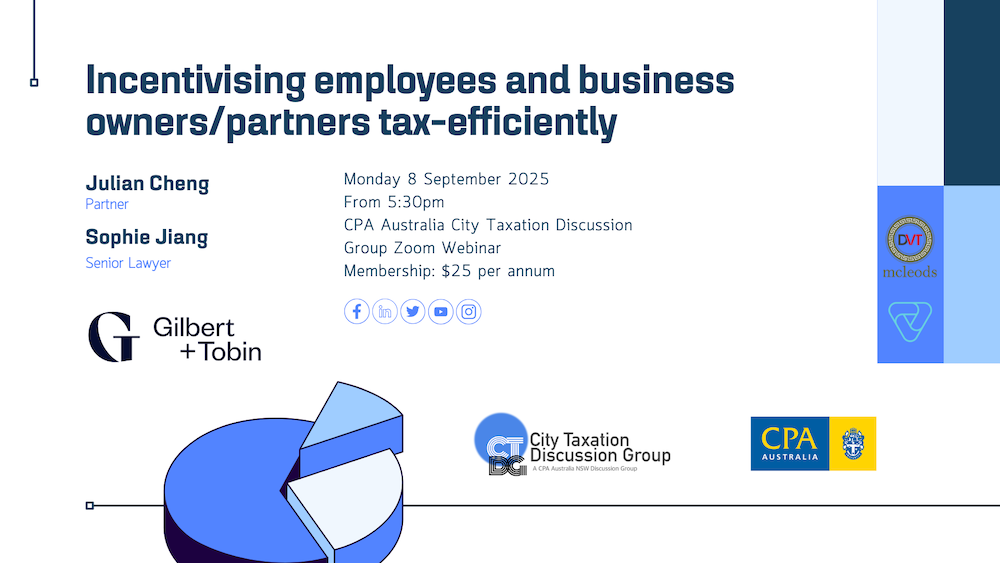
8 September 2025 | Incentivising employees and business owners/partners tax-efficiently | By Julian Cheng and Sophie Jiang from Gilbert + Tobin


- Description
- Curriculum
- Notice
- Reviews
-
1
 8 September 2025 | Recordings
We note that our live Zoom webinar has been completed.
Please refer to the recordings.
Please note that some videos may be large in file size and may cause the video player to take some time to load. We have attempted to reduce the file size as much as possible.
-
2
 8 September 2025 | Attendance Check
This quiz is set up as a final verification for the CTDG Convenors only. No action is required.
Summary
Employee Share and Option Plans
Julian explained the mechanics of employee share and option plans, highlighting how shares can be issued at market value or a discount, and options can be structured to have a nil market value. He detailed the tax implications under Australian law, noting that discounted shares or options are typically taxed upfront unless conditions for deferred taxation are met, such as vesting conditions and disposal restrictions. Julian also discussed the startup concession, which allows companies with specific criteria to issue discounted shares or options outside the employee share scheme rules, potentially offering tax advantages.
Employee Share Option Concession Plans
Julian explained the startup concession for employee share options, noting that it could apply to employees who hold less than 10% of the company, even if the options are exercised at a discount. Sophie discussed loan-funded share plans, which involve issuing shares at full market value using employer-provided loans, providing employees with upside potential without downside risk. These plans are particularly attractive when Division 83A conditions are not appropriate, and they offer flexibility in share classes and terms, such as ratcheting or flowering shares, often used in private equity contexts.
Tax Implications of Loan-Funded Share Plans
Sophie explained the tax implications of loan-funded share plans, focusing on Fringe Benefits Tax (FBT), Division 7A, and Capital Gains Tax (CGT). She highlighted that while Division 83A is not an issue, other tax considerations need to be addressed, particularly FBT for interest-free loans to employees and Division 7A for loans from private companies to shareholders. Sophie also discussed a potential solution to avoid Division 7A issues by structuring loans from Opco to employees who are shareholders of Holdco, as Division 7A only applies to loans from private companies to shareholders or their associates of the same company.
Loan-Funded Options and Professional Structures
Sophie explained the mechanics of loan-funded option plans, noting their similarity to loan-funded share plans but highlighting differences in FBT implications and CGT considerations. She emphasized that while loan-funded option plans are less common, they can be preferable in specific circumstances, particularly regarding CGT discounts. Julian then discussed professional practice structures, outlining regulatory frameworks and structuring considerations for different sectors, with a focus on companies as a common structure offering tax advantages and liability protection, while also noting the importance of understanding sector-specific rules and director duties.
Partnership Tax and Income Strategies
Julian discussed various business structures, focusing on partnerships and their flexibility in profit distribution, despite potential tax implications. He explained how partnerships differ from companies in terms of tax obligations and highlighted the use of service trusts to facilitate income splitting among partners and their families. Julian also touched on the ATO's guidelines for professional firm profits, emphasizing the need for commercially driven arrangements to avoid tax avoidance.
ATO Risk Assessment Framework Overview
Julian explained the ATO's risk assessment framework for professional practice structures, which evaluates profit allocation and tax rates across three factors to determine risk levels (green, amber, or red). He demonstrated the framework using a case study of a two-principal accounting firm, showing how the arrangement scored 8 points and fell into the amber zone due to the profit distribution and tax rate. The presentation concluded with guidance that practitioners should consider the regulatory framework before advising on structures, ensure commercial rationale for income splitting, and consult Julian or Sophie for further questions about management equity plans and professional practice structuring.